IC is a Necessary but Not Sufficient Condition

When evaluating factor-based strategies, the first indicator that comes to mind is IC (Information Coefficient). It measures the Spearman correlation between predicted returns and actual returns. A higher IC generally suggests a “good factor.”
However, in practice, factors with high IC may fail to generate expected returns. This doesn’t mean IC is wrong; it means relying solely on IC is problematic.
1. Turnover: Trading Costs Eat Alpha
Suppose you have a factor with an IC of 0.05. Building a portfolio based on this factor might produce promising excess returns on a monthly basis. But what if this factor requires weekly rebalancing?
Even with a transaction cost as low as 0.1%, weekly rebalancing incurs about 5% annualized cost. If the expected annual alpha from this IC-optimized factor isn’t higher than that, your net return may turn out negative.
It’s essential to check the factor’s autocorrelation first—how similar the current week’s factor value is to the next week’s. If autocorrelation is low, the positions change frequently, increasing costs.
import pandas as pd
from scipy.stats import spearmanr

# Calculate factor autocorrelation
factor_series = factor_df['factor_value']
autocorr_1 = factor_series.autocorr(lag=1)   # after 1 period
autocorr_4 = factor_series.autocorr(lag=4)   # after 4 periods

print(f"1-period Autocorrelation: {autocorr_1:.3f}")
print(f"4-period Autocorrelation: {autocorr_4:.3f}")
If autocorrelation exceeds 0.9, slow rebalancing is acceptable. If it’s below 0.5, frequent trading likely occurs, making cost simulation crucial.
2. Factor Clustering: Looks Like Diversification, But It’s Concentration
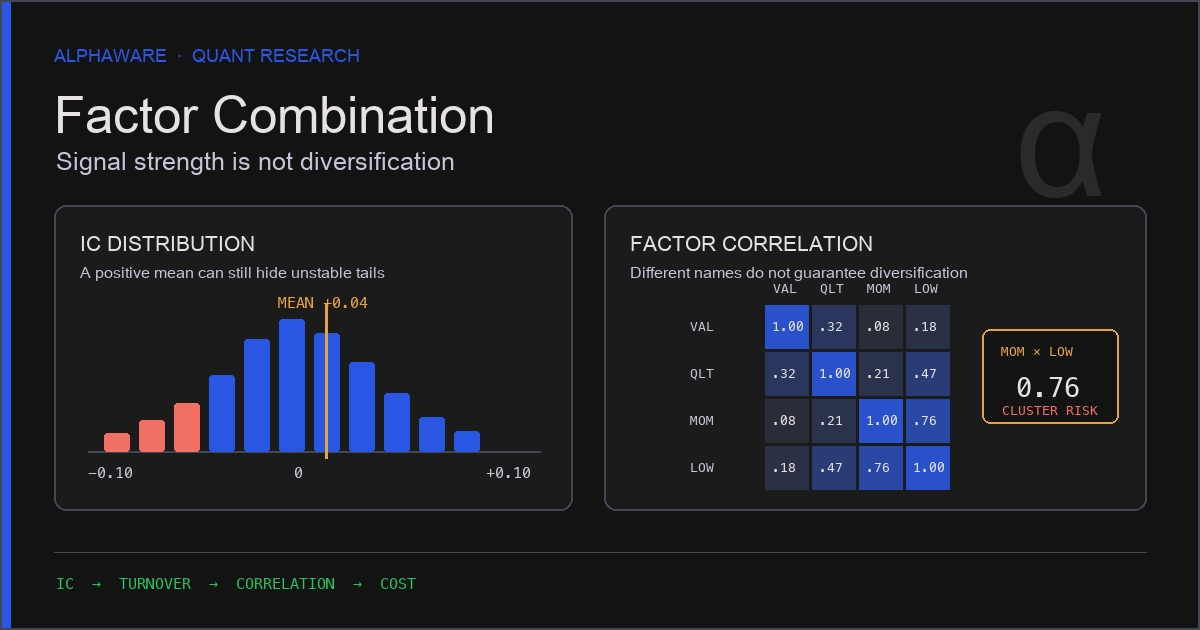
Combining 5–6 factors seems to diversify well. But if these factors are highly correlated, it’s hardly different from using just one.
A common example is the momentum factor suite. Using 3-month, 6-month, and 12-month momentum as separate factors may seem like a diversification, but their pairwise correlations often range from 0.7 to 0.9.
Before combining factors, it’s good practice to generate a correlation matrix.
import seaborn as sns
import matplotlib.pyplot as plt

# Factor correlation heatmap
corr_matrix = factor_df[factor_cols].corr(method='spearman')

fig, ax = plt.subplots(figsize=(8, 6))
sns.heatmap(corr_matrix, annot=True, fmt='.2f', cmap='RdBu_r',
center=0, ax=ax, cbar_kws={'shrink': 0.8})
plt.title('Factor Correlation Matrix')
plt.tight_layout()
If any factor pairs have correlation coefficients above 0.6, consider removing one or orthogonalizing them using PCA.
3. ICIR: Consistency Matters More Than Average IC
An average IC of 0.05, but with some months at 0.3 and others at -0.2, is unreliable in real trading. The reason is the lack of a clear position sizing framework.
ICIR (Information Coefficient Information Ratio) measures the stability of IC by dividing its mean by its standard deviation, similar to the Sharpe ratio.
import numpy as np

# Calculate ICIR
ic_series = []
for period in periods:
    returns = get_forward_returns(period)
    factor_values = get_factor_values(period)
    ic, _ = spearmanr(factor_values, returns)
    ic_series.append(ic)

ic_array = np.array(ic_series)
    icir = ic_array.mean() / ic_array.std()
    print(f"IC Mean: {ic_array.mean():.4f}")
    print(f"IC Std:  {ic_array.std():.4f}")
    print(f"ICIR:    {icir:.3f}")
Typically, an ICIR above 0.5 indicates a stable factor. If it’s below 0.3, even a high average IC isn’t very reliable.
4. Factor Decay Rate: How Long Does Predictive Power Last?
The holding horizon of the factor’s predictive power determines your rebalancing frequency. Does the factor maintain its edge after one month? Or does it vanish within a week?
Calculate ICs across different forward return horizons:
horizons = [1, 5, 10, 21, 63]  # 1 day, 1 week, 2 weeks, 1 month, 3 months
ic_by_horizon = {}

for h in horizons:
    forward_ret = returns.shift(-h)
    ic_vals = []
    for t in timestamps:
        ic, _ = spearmanr(factor.loc[t], forward_ret.loc[t])
        ic_vals.append(ic)
    ic_by_horizon[h] = np.mean(ic_vals)

# How does IC change over horizons?
for h, ic_mean in ic_by_horizon.items():
    print(f"Horizon {h} days → IC: {ic_mean:.4f}")
If IC remains high up to 21 days (~1 month), monthly rebalancing suffices. If it drops sharply after 5 days, weekly rebalancing becomes necessary, bringing rebalancing cost into focus.
Practical Checklist
Before including a factor in your portfolio, check these:
- Examine correlations among factors. Remove or orthogonalize pairs with correlations above 0.6.
- Check the autocorrelation. Low autocorrelation warrants careful cost modeling.
- Calculate ICIR. Values below 0.3 advise caution.
- Test how long IC remains stable over periods. This informs your rebalancing frequency.
- Simulate performance after deducting costs to ensure meaningful returns.
Relying solely on one IC number to judge a factor’s quality is like assessing a marathon runner solely based on their 50-meter dash time—it’s inadequate for decision-making.
Recommended Reading
Preventing Backtest Overfitting: Walk-forward vs. Purged K-Fold
Quant Investing? An Introductory Guide for Individual Investors
Getting Started with Python Backtesting: Validating Your First Strategy